Yarn Evenness Testing: Methods, Parameters, and Results
The evenness of yarns is directly related to the quality of yarns, the appearance of the fabric, the various processes, and the stability of the end products. This guide will provide information on how to check the evenness of yarns with a yarn evenness tester and will give details about important parameters like U%, CV%, yarn imperfections, and hairiness. In addition, ring spun, open end, air jet and filament yarns will be compared in terms of their evenness test and evenness characteristics.
Yarn Evenness Characteristics of Ring-Spun Yarn
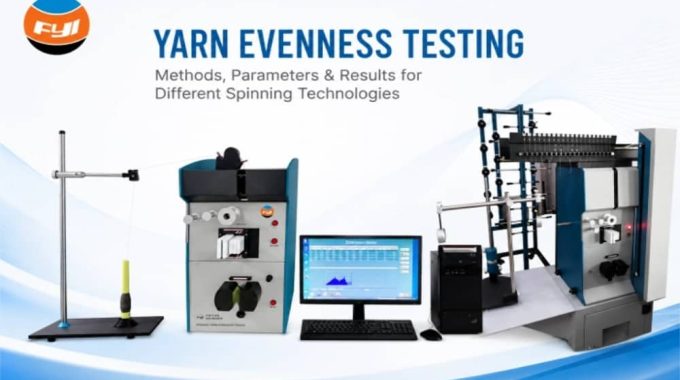
The evenness of ring spun yarn is usually desirable for its smoothness, strength, and uniformity; however, the quality of fibers, drafting control, twist, and spinning conditions all have a high degree of influence on the evenness of ring spun yarn. A yarn evenness tester is used during the testing process to assess if the yarn is meeting the required quality by measuring the mass variation along the yarn as well as identifying periodic irregularities. Check our Yarn Evenness Tester SPIN5600/SPIN5600H.
Key characteristics include:
- CV% and U%: A general reference to the variation in the mass of the yarn. The lower it is, the more even it is.
- Local mass variations that may influence the fabric appearance and/or the processing performance, called thin and thick places.
- Neps: Small fiber or entangled-fiber defect, which can become noticeable in the dyeing or formation of fabric.
- Hairiness: Caused by fiber properties, twist and spinning conditions, and may be applied to the surface properties.
- Periodic variation: Periodic irregularities in mass could be a sign of drafting irregularity on the component, rollers or other spinning-machine parts.
There is a need to prepare the fibres in the same way, draft them, insert the twist, and set the machine at the same speed to achieve evenness in ring spun yarn production.
Yarn Evenness Testing Methods for Open-End Spun Yarn
The fiber arrangement of open-end spun yarn is different from that of ring-spun yarn; therefore, the evenness characteristics of open-end spun yarn should be tested by appropriate parameters. A yarn evenness tester is used to find mass variation along the yarn and irregularities, which can be a problem in downstream processes and fabric quality.
Sample Preparation and Conditioning
Precondition under controlled atmospheric conditions and make sure the test package is not damaged or contaminated before conducting the test. Evaluate more than one yarn package with representative samples to get reliable results rather than examine one package.

Measuring U% and CV%
Yarn mass uniformity is important and can be measured by the U% and coefficient of variation (CV%). The mass variation of a test length is continually measured by the yarn evenness tester. A lower U% and CV% value is usually better, but will vary based on application, fiber, and yarn count.
Detecting Thin Places, Thick Places, and Neps
Localized mass variations can be differentiated using an automatic evenness tester into thin places, thick places, and neps. Open-end yarns are especially sensitive so that any imperfections that might occur during the collection or spinning process could show in the yarn.
Evaluating Yarn Hairiness
To measure fibers projecting from the surface of the yarn, hairiness testing is used. Hairiness is not only excessive but also inconsistent, so it could affect the appearance of the fabric, pilling, friction, and then processing. If the instrument is capable of measuring the hairiness of the product, it should be used in conjunction with the mass measurement.
Analyzing Periodic Irregularities
Periodic faults may be a sign of an opening/drafting, rotor, delivery, or winding fault. If repeating variations are present, these can be detected by spectrogram analysis and their mechanical origin may be determined, thus enabling the separation of random irregularity from mechanical.
Comparing Results Across Yarn Packages
Multiple testing of packages helps to ascertain if there is a problem with the package in itself or if it is a wider manufacturing problem. Identify trends and keep the quality of open-end yarns consistent by comparing the CV%, U%, imperfections, hairiness, and patterns on the spectrograms.
Testing Requirements for Air-Jet Spun Yarn
Air-jet spun yarn is a unique type of yarn with high-speed air vortices that is wound by wrapper fibers around the core of the yarn. The overall uniformity of the yarn may not be the only thing that needs to be considered when testing this structure because it can affect mass variation, hairiness, strength, and imperfections. The use of an appropriate filament yarn evenness tester can be used to determine any general variation and any localized fault.
Controlled Sample Conditioning
Treat yarn sample to standard temperature and relative humidity before testing. The effect of moisture and environmental changes on the mass of the yarn is minimised by proper conditioning, and the results of one sample is comparable to another.
Measurement of U% and CV%
Use the mass variation measurement, U% and CV%, to quantify overall mass variation of air-jet spun yarn. A lower variation typically is more uniform. The results of the tests should be compared with the yarn count, fiber content and purpose of use specified rather than with a single universal acceptance value.
Detection of Thin Places, Thick Places, and Neps
As a result of fiber feeding, drafting and vortex formation, there are certain imperfections which can be made in the fiber as it passes through the air-jet spinning apparatus. The tester should therefore be able to note the occurrence of neps, thin places and thick places over a specified test length to look out for yarning faults of the yarn that may affect the appearance of the fabric.
Hairiness Evaluation
The air-jet spun yarn is an important parameter in which the hairiness plays a part since it can give a different surface appearance from ring spun yarn due to its unique wrapper-fiber structure. Measure the hairiness for the tested fabric in the fabric region where it can be measured and compare with the desired fabric and processing performance.

Spectrogram and Periodic Fault Analysis
Employ spectrogram analysis to detect periodicities that might be drawn out in the components, feed of the fibers, air-jet conditions, etc., caused by the machine. Periodic faults should not be left as an unpredictable variation in the yarn, and should be investigated.
Test Speed and Test Length
Use the same test speed, test length, and instrument settings for all samples. By changing these parameters between tests, the number of imperfections could change, and comparisons might be misleading.
Replicate Testing and Result Comparison
Use a series of packages or specimens from a single production lot to obtain representative results. Compare CV%, U%, imperfections, hairiness, and periodic variation between samples to see if the irregularity is a sample problem or a problem with the process.
Comparison of Yarn Evenness Results Among Different Spinning Methods
The evenness of the yarn is dependent of the spinning system, fibre arrangement, drafting system, twist, and machine conditions. By comparing test results of ring-spun, open-end and air-jet spun yarns, you will be able to learn the impact of each spinning technology on mass variation and yarn imperfections. If comparing, make sure that the testing conditions and yarns are the same.
Ring-Spun Yarn
Ring-spun yarns are typically quite even overall because the attenuation of the fibers is controlled prior to the addition of twist. Its quality is usually determined by U%, CV%, thin places, thick places, neps, and hairiness. Drafting stability and spindle speed, fiber quality and twist level can have a great impact on the end product.
Open-End Spun Yarn
The fiber arrangement in open-end yarn differs since the fibers are separated and picked up prior to the yarn formation in the rotor. The evenness results may vary from ring spun yarn, especially about imperfections and periodic mass variation. Results of tests should be interpreted in the light of rotor speed, opening performance, fiber feed and yarn delivery conditions.
Air-Jet Spun Yarn
Air-jet yarn is made by the use of high-speed air vortices to create a core and wrapper structure. It should be tested considering mass variation, imperfection, hairiness, and periodic faults. The structure of the wrapper fiber may affect the surface characteristics, and therefore the CV% of air-jet yarns should not be compared solely based on quality.

Key Parameters for Comparison
| Parameter | Ring-Spun | Open-End | Air-Jet |
| U% / CV% | Overall mass variation | Overall mass variation | Overall mass variation |
| Thin places | Local mass reduction | Local mass reduction | Local mass reduction |
| Thick places | Local mass increase | Local mass increase | Local mass increase |
| Neps | Fiber-related imperfections | Rotor/fiber-related faults | Fiber-formation-related faults |
| Hairiness | Often significant | Structure-dependent | Strongly affected by wrapper fibers |
| Periodic faults | Drafting/machine related | Rotor/feed related | Air-jet/drafting related |
How Spinning Technology Affects Yarn Evenness Performance
An apparatus for yarn evenness testing is useful to assess the mass variation, imperfections, hairiness and periodic faults in various spinning technologies. All three types of yarns (ring spun, open end and air-jet) have different structures and performance properties, and should be interpreted to the context of the spinning technique and the use of the yarn. Reliable yarn evenness tester, stable test conditions are of great significance for the manufacturer to ensure the stability of yarns and early detection of problems in the production process.
Conclusion
The evaluation of mass variation, imperfections, hairiness, and periodic faults can be done in various spinning technologies using yarn evenness testing. Different types of yarns, such as ring spun, open end and air jet, have different characteristics, so it is important that they are tested consistently to be able to compare yarns and to monitor the process. Using a good yarn evenness tester will enable you to spot irregularities early and ensure consistent performance of your yarn.
Choose the Right Yarn Testing Solution
Looking for reliable equipment for yarn evenness, filament evenness, and textile quality testing? Explore FYI Tester’s testing solutions to find equipment suited to your laboratory and production requirements. Contact us for further information!