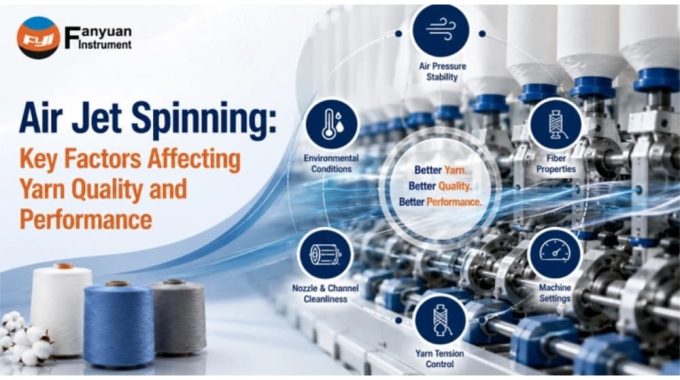
Air Jet Spinning: Key Factors Affecting Yarn Quality and Performance
Air jet spinning can give you high production speeds and distinctive yarn characteristics, but the final yarn quality depends on how well you control the spinning conditions. Fiber properties, air pressure, nozzle design, drafting, twist formation, and machine settings all influence strength, evenness, hairiness, and yarn appearance. By understanding these factors, you can adjust the process more precisely, reduce defects, and achieve consistent yarn performance for your intended fabric application.
1. How Fiber Length Affects Air Jet Spinning Performance
Fiber Length and Yarn Strength
The longer the fibers are, the more contact points they have within the yarn, which means they can help to create greater fiber cohesion and resistance to slippage. This will enable the yarn to be more stable and hard to break during the following process.
Short Fibers and Yarn Irregularity
More short fibres would provide more control of fibre in the drafting and air-jet twisting processes. There may be more variation in fiber length distribution with increased unevenness, hairiness, and fiber loss, particularly in wide fiber length distribution.
Matching Fiber Length to Process Settings
The lengths of the fibre should be determined according to the spinning system, the drafting conditions and the properties of the yarn required. Matching of the fibres is significant in terms of fibre control, evenness, surface quality and uniformity of strength. The quality of the yarns produced is affected by changes in air pressure during the air jet process.
2. Effect of Air Pressure on Air Jet Spinning Yarn Quality
Air Pressure and Fiber Wrapping
The air pressure determines the force of air flow, which moves the surface fibres around the core of the yarn. If properly adjusted, it can help to create a more uniform yarn structure and fiber binding. Too much or too little pressure can upset the flow of fiber and decrease the structural stability.
Air Pressure and Yarn Strength
The pressure level influences the success of the incorporation of fibres into the yarn. Adequate ventilation will help maintain good cohesion and maintain good tensile strength. The pressure may be ineffective, thus causing uneven wrapping, which could lead to more variability in the yarn and adversely affect the yarn strength.

Air Pressure and Yarn Evenness
Air pressure can be used as another means of obtaining an even yarn. If it is set at an improper position, the fiber wrapping may be irregular and result in greater mass variation and surface defects. To obtain more uniform yarn, the pressure should be maintained inside the machine and must be kept within the permissible working range of the machine.
3. How to Control Yarn Twist in Air Jet Spinning
Adjust Air Pressure for Fiber Rotation
The twist and how it is distributed can be adjusted by changing the pressure of the compressed air that is supplied to the spinning nozzle. Rotation of the free fibre ends around the emerging yarn is produced by the vortex created by the flow, maintaining the free fibre ends aloft.
In cases of low pressure, the fibre wrapping may be inadequate, yielding poor cohesion and/or high hairiness. If it is too high, it may result in excessive fibre movement, impacting the structure of the yarns and increasing energy usage. Hence, it becomes essential to select the pressure depending on the type of fibres, yarns, and the desired properties of yarns.
Optimize Nozzle Geometry
Another factor to take into account is the geometry of the nozzle, which dictates the airflow to the spinning chamber, its rotation, and exit. The nozzle angle, chamber design and direction of airflow can all affect fiber rotation and wrapper fiber formation. Better wrapping stability and a consistent yarn structure are more desirable not just through an increase in air pressure, but through a suitable configuration.
Control Drafting and Delivery Speed
Other factors such as drafting and delivery speed can also influence the formation and distribution of twist. Increasing the delivery speed without adjusting the spinning condition accordingly will cause the fibres to take less time to react to the air vortex, thus impacting wrapping and yarn stability. The amount of drafting, roller setting, and delivery speed must be adjusted according to the airflow conditions to ensure consistent fiber control.
Learn: Yarn Evenness Tester
Match Twist With Fiber Characteristics
When establishing the twist-related parameters, you must take into account the length, fineness, strength, and friction of the fiber. The longer fibers might wrap and integrate differently than the shorter fibers, and the finer fibers might react differently to the air stream. When considering these properties of the spinning conditions, you can maintain the desired yarn strength, evenness and hairiness while avoiding the production of excessive wrapper fibres.
Monitor Twist Distribution
Average twist value should not be taken as the only measure of twist; the yarn should be evaluated across the yarn. Disparity in wrapping fibers may cause fluctuations in yarn strength, even when the general twist seems to be in the “safe” range, as well as differences in yarns’ appearance and abrasion resistance. By regulating the air pressure, nozzle setting, draft, and delivery speed, you can detect unstable spinning and adjust the parameters as needed.

4. Common Yarn Defects in Air Jet Spinning and Their Causes
Uneven Yarn
Yarn thickness may vary in situations of fiber feeding, drafting and fiber distribution instability. Drafting errors, sliver inconsistencies and fiber length distribution can result in uneven mass in the yarn. These variations can be minimized by maintaining consistent drafting conditions and by keeping track of the material being drafted.
Excessive Hairiness
Hairiness is caused by fibres being retained incompletely or by projecting from the surface of the yarn. If the air pressure, nozzle shape or ability to control the fibers are not suitable, there will be an increase in hairiness. Length of fibers and preparation are important considerations since short fibers can easily slip out of the main yarn structure.
Low Yarn Strength
If the fibers are not sufficiently cohesive around the core of the yarn, then you might get reduced tensile strength. This can be caused by inadequate airflow, incorrect drafting, improper fiber alignment, or excessive fiber separation. The airflow and drafting conditions should be balanced to allow the wrapper fibers to provide good binding, without the formation of an unstable structure.
Read More: Yarn Evenness Tester Speed and Test Length
Thick and Thin Places
Thick and thin places can form in a fluctuation of the fiber stream that enters the spinning zone. All of these may contribute, such as irregular sliver, drafting-wave formation, roller setting errors, and fiber control issues. These can be minimised by holding the feed material constant and by correct setting up of the drafting system.
Fiber Clumps and Slubs
Slubs are seen as thick spots that are localized from fibers that have accumulated or are not controlled. These can be seen if the fibres are not separated sufficiently or if contamination gets into the process or if the drafting is not stable. These localized defects can be avoided by regular cleaning, the proper preparation of the fibers, and stable drafting conditions.
Excessive Fiber Loss
The amount of fiber loss is inherent to air jet spinning, and if too much fiber loss occurs, it may be a sign of poor process control. Higher losses can be experienced if airflow is excessive, fiber length is inappropriate, or spinning conditions are inadequate for controlling loose fibers. To maximize the yield of the fibres, airflow and raw material should be optimized.
5. How to Improve Yarn Strength in Air Jet Spinning
Select Suitable Fibers
Strength of yarns can be increased by proper choice of fibres in terms of length, fineness, strength and uniformity of length. Longer and stronger fibers tend to have a superior degree of fibre integration and will minimise slippage in the yarn. Also, keep the amount of short fibers as low as possible, since if the short fibers are not controlled, they may reduce the strength of the yarn.
Optimize Drafting Conditions
Stable drafting is needed before the fibers are pulled into the spinning zone to ensure that they are oriented correctly. There are several risks involved with over-drafting, such as excessive fiber separation and irregularity, and under-drafting may result in poor fiber control. Properly spaced separators, drafting ratio, and fiber preparation ensure you get a more even fiber strand to spin.

Adjust Air Pressure
The goal is NOT to increase the air pressure to get stronger yarn, but to optimize it. Giving the product the right pressure will create the right amount of migration and wrapping of surface fibres around the core. Pressures that are either too high or too low can cause entanglement of fibers or cause too much turbulence in the processing, respectively.
Optimize Nozzle Settings
Wrapping of the fibers around the yarn core is very sensitive to nozzle design and operating parameters. Strength can be improved by using a nozzle configuration to obtain stable airflow and consistent fibre wrapping. Proper alignment and cleanliness is also important as a deposition or a damaged part can affect the airflow pattern.
Control Spinning Speed
The delivery speed should be matched to the type of airflow and fibre that has been selected. An excessive rate may decrease the time that is allowed for the migration and wrapping of fibers, resulting in a decrease in yarn stability. Determine the correct speed to keep your productivity while maintaining the correct strength and consistency.
Maintain Consistent Feed Material
If the sliver entering the yarn machine continually changes in mass or fiber distribution, then the strength of the yarn will never be stable. Ensure the carding, drawing and feeding conditions are held constant for the spinning unit so that a uniform fiber stream is provided. You can then detect changes in the process through regular yarn strength and evenness testing, which will help you prevent bigger quality issues.
Conclusion
Overall, you can improve air jet spun yarn strength by carefully balancing fiber selection, drafting, air pressure, nozzle conditions, and spinning speed. Consistent process monitoring helps you identify strength losses early and maintain stable yarn performance. If you want to achieve stronger, more consistent air jet spun yarn, evaluate your current spinning parameters and optimize each factor according to your fiber and production requirements.