
What is Melt spinning? Process, Materials, and Machine Guide
Have you ever wondered where do all the threads for Nylon, Polyethene, and PET come from? You’ve seen them in fabric labels, but to produce these industrial fabrics and plastics, you’d use a process called melt spinning.
Melt spinning is used to produce synthetic fibers, multifilament yarns, microfibers, and even medical textiles. Melt spinning machines rely on rapid cooling of thin fibers to produce continuous filaments and metal ribbons.
What Is Melt Spinning?
Melt spinning is the most popular method to produce fibers and metal ribbons. Let’s break down the metal spinning process:
In metal spinning, you heat the material until it reaches a molten state, then force it through a spinneret or a cooling wheel. The most crucial step is the instant transition from liquid to solid that gives long, uniform fibers that maintain the desired chemical composition.
Materials Used in Melt Spinning
If you think any material can be made into fibers using melt spinning, you’d be wrong because the melt spinning machine can only process certain materials. The selection of materials depends on the desired fiber product.
Melt spinning materials are divided into thermoplastic polymers and specific metal alloys. Both made using different machines: polymer fiber lab melt machine and metal ribbon melt machine.
| Polymers | Melt Temperature | Primary End Product |
| Polyethylene Terephthalate (PET) | 260 – 300°C | Textile filament, technical yarns |
| Polyamide 6 (PA6) & 6,6 (PA66) | 250 – 280°C | Clothes, carpets, cords, tires |
| Polypropylene (PP) | 180 – 250°C | Carpets, nonwovens |
| Weighted Polyethylene (UHMWPE) | 150°C | Fibers for strong ropes |
Table of melt spinning polymer materials
| Metal Ribbons | Melt Temperature | Primary End Product |
| Iron-Based Alloys | 1200 – 1400°C | Ribbons for transformer cores |
| Nickel-Based Alloys | 1100 – 1300°C | Magnetic shields, |
| Cobalt-Based Alloys | 1100 – 1300°C | Magnetic cores, |
| Bulk Metallic Glasses | Prototypes, biomedical applications |
Table of melt spinning ribbon (metal) materials
Melt Spinning Machine Overview

A melt spinning machine is a complex system that has many moving parts with the majority of the electronic complexity around its temperature sensors and spinnerets. It is designed to convert molten material into continuous fibers through extrusion and rapid solidification.
At the core of the melt spinning machine sits a heated melting unit or extruder that brings polymer to a precise melt temperature and at the same time, maintains viscosity. This melt/molten state is important for the extruder. The molten material is forced through a spinneret with holes.
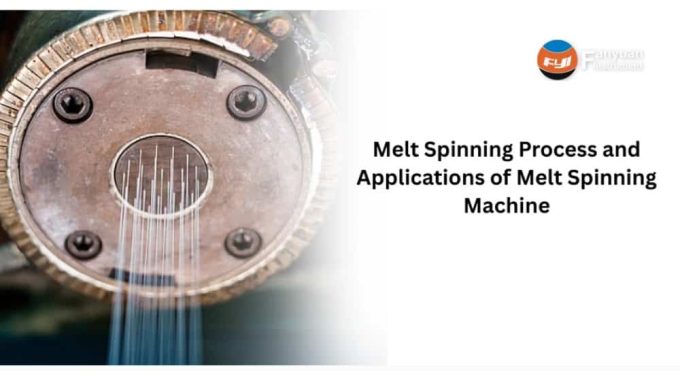
The hole geometry influences the fiber diameter, and immediately after extrusion, the fiber is quenched (in air) or inert gas and attached to a high-speed rotating drum. The melt spinning machine controls the take-up speed, which affects the fiber surface finish and mechanical properties.
Main Components of a Melt Spinning Machine
- Extruder/Heating Chamber: An extruder is used to convert solid pellets into a homogenous mixture.
- Metering Pump: A high-precision gear pump for an equal and constant flow of plastic.
- Spin Pack: The spin pack holds the filtration chamber and the spinneret
- Spinneret: A spinneret is a metal plate with micro holes (capillaries) that sharpen the extrudate.
- Cooling System: This can be an open air space or a cold gas flow to solidify the substrate.
- Take-up Mechanism: The take up mechanism varies between melt spinning machines. Melt spinning machine uses rollers or winders that collect the solidified fiber at specific tensions and flow rate.
Melt Spinning Process Step-by-Step

Feeding
The first part of the melt spinning process uses raw materials in the form of chips, pellets or granules. These are fed into a hopper where a vacuum chamber removes any moisture to prevent hydrolytic degradation.
Melting and Extrusion
The extrusion process and the melting process usually happen in the same chamber for homogeneity. The material moves into a heated barrel with a rotating screw. The screw is designed in a way that pushes material forward and compresses it to remove any air pockets.
Filtration
Before finally extruding the melt material through a spinneret, the melt plastic passes through a filtration unit, as described earlier as “spin pack”. The spin pack has a metal mesh and layers of filtering media like sand that stop any coagulated plastic, cut-off gel particles, and impurities that can block the spinneret microholes.
Metering
A specific metering pump controls the volume of molten material delivered to the spinneret. This component maintains fiber thickness and uniformity. Another thing the metering pump in a melt spinning machine is used for is to maintain a steady throughput despite fluctuations in extruder pressure.
Extrusion through Spinneret
The uniform melt is forced through the spinneret holes. The geometry of these holes determines the shape of the fiber. There are many types of shapes, like round, trilobal, and hollow. For metals, the metal melt is ejected through a narrow slit instead of holes.
Solidification
As the molten/melt streams exit the spinneret, you’d expect them to drip, but actually they go through a “quench zone”. A flow of cool air is blown across the filaments to solidify the melt instantly.
Melt Spinning for Metals
In the melt spinning development for metals, there is a bit of chemistry involved. The melt spinning machine’s goal is to bypass crystalline solidification to form an amorphous structure. The metal is fixed in a crucible where it is melted, and the molten alloy is ejected under gas pressure from the crucible nozzle onto a spinning copper wheel. Copper has a high thermal gradient, so what essentially happens is the molten metal chills on the wheel and the atoms don’t go through the slower process of aligning to a crystalline lattice, resulting in a metallic glass.
Parameters Affecting Fiber and Ribbon Quality

Temperature Control (Melt and Extrusion Temperature)
The melt temperature is important for melt spinning because you’re aiming for a low viscosity flow. It should be low enough for extrusion but not so low that there is thermal degradation.
Extrusion Rate and Throughput
The extrusion rate affects the mass of the fiber produced. A higher throughput can lead to melt fracture when the shear rate exceeds material limits.
Cooling Rate and Quench Medium
The quenching medium, whether air, gas, or chilled wheel, determines the crystallinity If you cool the fibers or metal at a slower rate, you get more crystal growth and atom alignment.
Wheel/Nozzle Gap and Surface Speed (Particularly for Metals)
In metal spinning, the distance between the nozzle and the cooling wheel, along with the wheel’s spinning speed, determines the thickness of the resulting ribbon.
Draw Ratio and Take-Up Speed
The take up speed is almost always faster than the extrusion rate. It is important to factor in the ratio between these speeds called the draw ratio. Draw ratio influences molecular orientation which affects the strength of the fiber.
Applications of Melt Spinning
Melt Spinning in Textiles
Melt spinning has its largest use in the textile industry. It produces filament yarns for your woven and knitted fabrics, clothing, carpets, and sewing threads.
Melt Spinning for Synthetic Fibers
Melt spinning methods are also popularly used to produce synthetic fibers like polyester and nylon. Some of these applications go beyond technical textiles like seatbelt yarns, and tire cords.
Magnetic Components
Magnetic ribbons are widely used in sensors and electronic equipment. These ribbons are often made from a cobalt based alloy that is used in melt spinning to produce the magnetic ribbon.
Advanced Materials
Some advanced application materials, like surgical sutures, use non-absorbable polymer filaments, and some HEPA filters also use fibers made from melt spinning.
Advantages and Limitations of Melt Spinning
Advantages of Melt Spinning Machine
- High production speeds: Melt spinning machines are capable of take-up speeds that are more than 6000 per minute which increases the production efficiency for these fibers.
- No solvents: Melt spinning method remains one of the most efficient and popular polymer fiber-producing processes that don’t use any chemicals and solvents for solidification.
- Control of fiber quality: Melt spinning method allows you to adjust the fiber diameter, shape and cross-section.
- Metal structure: Melt spinning method allows you to produce a unique metallic structure that is not possible using traditional casting and machining.
- Production efficiency: Melt spinning machine can work 24/7 to produce continuous fiber rolls.
Conclusion
Melt spinning is an important manufacturing process that is used to supply materials for high-performing synthetic fibers and advanced metal alloys. Essentially, altering the thermal gradient and extrusion process allows you to engineer the desired synthetic fiber without any solvent.
Get In Touch
Phone: +86-551-68 105003
Phone: +86-551-68 105008
Fax : +86-551-6523 2507
Email: [email protected]
Email: [email protected]
MAIL US
If you have any need please contact with us, or if you have any problem, please send email to us anytime.


