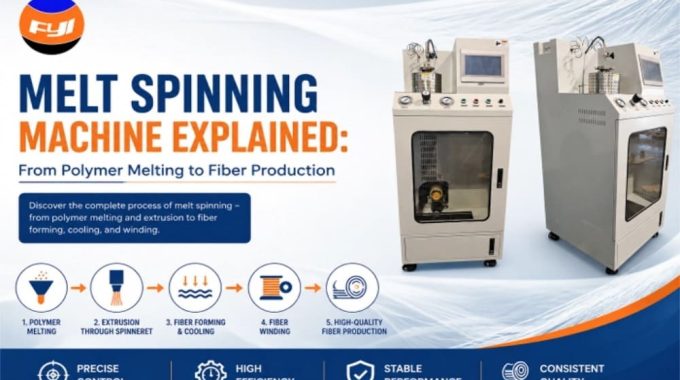
Melt Spinning Machine Explained: From Polymer Melting to Fiber Production
A melt spinning machine consists of a combination of melting, filtering, extruding, cooling, and drawing equipment that is used to produce continuous filaments from thermoplastic polymers by a controlled process. The process is basically controlled by the melt rheology, thermal management, and molecular orientation, which are responsible for the uniformity of the filament and eventual mechanical properties.
Melt spinning begins with solid polymer feedstock and finishes with oriented fibers in package form, which can be used for further textile or industrial processing. The most important process parameters that determine process efficiency in polymer melt spinning are the stability of melt flow, the temperature zoning, and the draw ratio.
Core sequence:
Polymer → Melt → Filter → Spin → Cool → Draw → Wind
Melt Spinning Process
Polymer Preparation and Melting
Moisture is removed from polymer chips during drying to prevent them from degrading molecular chains when heated. This material is then subjected to shear under controlled conditions in the extruder part of the melt spinning machine, where it is heated above its melting point and converted into a homogeneous melt.
Filtration and Metering
The molten polymer is fed through filtration systems to remove gels and solid impurities, for stabilising the flow of polymer. A precision metering pump then controls the flow of melt, providing a constant volumetric flow and maintaining a constant linear density of the filament.
Spinneret Extrusion and Quenching
The melt is extruded through spinneret capillaries, which set the filament count and geometry. The internal structure formation and crystallization behavior can be affected by the cooling rate during the controlled air quenching immediately after the extrusion processing.
Drawing and Winding
The solidified filaments are drawn through a pair of rollers to orient the molecules, thus increasing the tensile strength and modulus and decreasing the elongation. The fibers are then wound into packages, which are either partially or fully oriented yarns, depending on the process conditions.
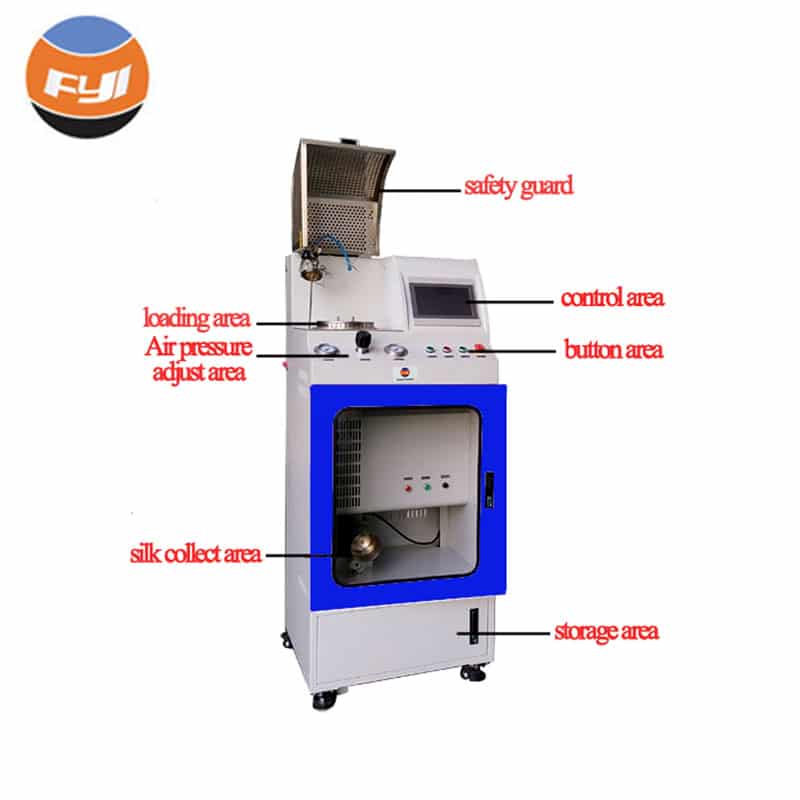
How to Choose the Right Melt Spinning Machine
The choice of a melt spinning machine is based on the polymer rheology, thermal demands, and production goals. For PET systems, high-temperature stability and precise drying integration are important, whereas for polypropylene systems, energy-efficient melting and stable flow control are a priority. Moisture control and quick thermal response are crucial to nylon systems.
Machines need to not only be capable of the nominal production rate but also be configured to meet the required process precision, production continuity, and filament fineness.
Lab Scale Melt Spinning Systems vs Industrial Melt Spinning Systems
Lab Scale Systems
Lab-Scale Systems are developed and used for materials testing and process development. They are operated at low throughput, and offer high configurational flexibility – temperature profile and draw ratio, and spinneret configuration can be varied.
Lab-scale systems are used for low throughput experiments with simpler mechanical architectures and industrial systems combine continuous spinning, drawing and winding line for sustained high throughput production. Switching from batch-like control to continuous operation causes a considerable amount of engineering complexity, which is directly correlated to capital cost.
Industrial Systems
Industrial polymer melt spinning systems are tailored to produce polymer materials continuously and in high volume. They are used in synchronized lines where process stability, reproducibility, and output efficiency are the main concerns, rather than experimental flexibility, which involves mixing, spinning, drawing, and winding (SDW).
Price Factors for Melt Spinning Machines

The cost of Melt Spinning Machines depends on several factors, which are listed below:
Level of Automation and Control Architecture
One of the key factors influencing the price is the level of automation. Basic systems involve manually or semi-manually controlled temperature and speed, while the more sophisticated include PLC or computer-based controls from the industrial sector. Closed loop feedback control of the melt pressure, temperature zoning and line speed synchronization are included in high-end melt spinning process lines, which adds precision and complexity to the system and sensor density, resulting in higher system cost.
Extrusion and Melt Delivery Design
The precision of the extrusion system screw geometry and gear pump precision affects the cost. In order to enable stable polymer melt spinning, the use of high-accuracy metering pumps and thermally stable extruder barrels is necessary. Better melt homogenization and pressure stability eliminate filament irregularities, but increase the tolerances that must be achieved in the manufacturing process and the mechanical strength of the components.
Spinneret Engineering Complexity
One of the most cost-sensitive elements of a melt spinning machine is the spinneret design. The high hole density, micro-scale precision of the holes, and the particular cross-sectional shapes lead to special technologies of drilling and finishing. The finer and more uniform the requirement, the more complex the manufacturing process becomes, and the higher the manufacturing cost.
Material Selection and Thermal Resistance
The price and durability of the machine depend on the construction material used. Typical stainless steel systems can be used with common polymers, but alloy-based and corrosion-resistant materials are needed in high-temperature and/or chemically aggressive environments. In addition, the continuous melt spinning method operations are more complicated because of the thermal stability requirements.
Throughput Speed and Line Stability Requirements
For faster production, improved mechanical rigidity, vibration control, and synchronization for the spinning, drawing, and winding are needed. By making the filament more uniform at high line speed, it will increase the constraints of the system, and greatly increase the engineering and manufacturing costs of stable operation for a long time.
Customization Options in Melt Spinning Equipment
Spinneret Design
The hole diameter, number of capillaries, cross sectional geometry of the spinneret can be varied to create fibers with different deniers, number of filaments, and useful properties. The precision of the spinneret design directly affects the fiber uniformity, orientation, and end-use.
Extrusion Configuration Customization
The single-screw and twin-screw extruders can be installed in a melt spinning machine to process the corresponding polymer and formulation. Twin-screw systems are used for the best mixing/dispersion of polymer blends, fillers, color masterbatches, and functional additives, whereas single screw extruders are recommended for stable processing of conventional thermoplastics.
Quenching and Cooling System
Filament solidification and crystallization can be controlled by the engineering of cooling systems using cross-flow, radial, or multi-zone air quenching. Adjustable airflow velocity and temperature provide greater process stability and optimization across various polymer and fiber types.
Drawing and Winding Modules
Downstream equipment can also be customized to provide a variety of drawing stages, heated godet rollers, and precision winding units to ensure the desired draw ratio, molecular orientation, and package quality. Such setups allow the production of fibres with specific mechanical properties and dimensional uniformity.
Automation and Process Monitoring
Advanced polymer melt spinning systems can have a PLC-based system that is automated, an HMI interface, and real-time recording of temperature, pressure, melt flow, and line speed. Closed-loop control will reduce the variation of the process, enhance production efficiency, and bring the quality of the fiber to be consistent for long production periods.
Common Issues and Fixes
1. Uneven Fiber Thickness
- Cause: unstable melt flow
- Fix: recalibrate pump and stabilize pressure
2. Filament Breakage
- Cause: incorrect cooling or low viscosity
- Fix: adjust quench air and temperature profile
3. Spinneret Blockage
- Cause: contamination or polymer degradation
- Fix: improve filtration and cleaning cycles
4. Weak Mechanical Properties
- Cause: insufficient drawing ratio
- Fix: optimize stretching speed and temperature
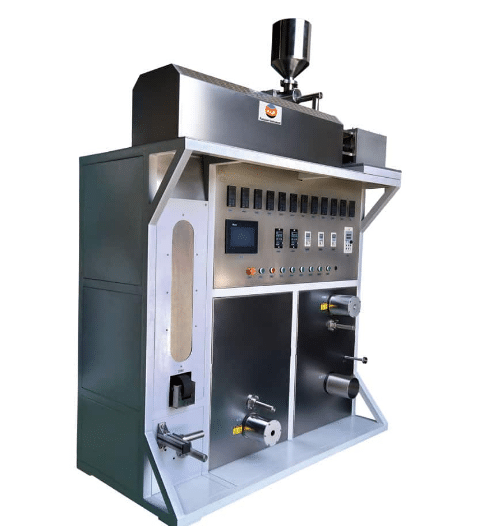
Maintenance and Troubleshooting of Melt Spinning Machines
The stability of the melt flow, uniformity of the melt temperature, and cleanliness of the melt flow path are all essential to the operational reliability of a melt spinning machine. Spinneret clogging generally is caused by polymer degradation or inadequate filtering, and filament diameter variations are generally related to problems with the metering pump.
The most frequent causes of fibre breakage are due to incorrect cooling profiles or draw ratios. The regular maintenance involves cleaning the spinners, replacing filters, tuning the gear pumps, and checking the accuracy of the thermal sensors to maintain stable process conditions and fiber quality.
Conclusion
To conclude, the melt spinning machine is a central part of the polymer melt spinning process. Thermal stability, rheological control, and molecular orientation are significant factors in the spinning process, making it a dominant process in the manufacture of synthetic fibers.
Ready to optimize your fiber manufacturing? Explore the melt spinning process and see how advanced spinning machines deliver consistent, high-performance fiber production.
Frequently Asked Questions
What is a melt spinning machine?
Equipment that melts thermoplastic polymers and extrudes them through a spinneret to form continuous fibers of synthetic polymers of controlled dimensions and properties is called a melt spinning machine
Which polymers can be processed by melt spinning?
Typically, polyester (PET), polypropylene (PP), polyethylene (PE), nylon (PA), polycarbonate (PC), PLA, PEEK, and other thermoplastic polymers that do not decompose during melting are used.
What is the difference between polymer melt spinning and solution spinning?
Polymer melt spinning is a process in which the polymer is molten without the addition of solvents, while solution spinning involves dissolving the polymer in a solvent prior to the addition of solvent. In general, melt spinning is a faster, cleaner and cheaper process for thermoplastic materials.
What factors affect fiber quality during the melt spinning process?
The quality of the fiber produced is influenced by the polymer melt temperature, the pressure of the extrusion, type of spinneret, cooling, drawing ratio, winding speed, and process control.