

Textile Pilling Resistance Testing and Analysis of Common Causes of Pilling
Fabric fuzzing and pilling are significant factors affecting a fabric’s hand feel, appearance, and performance in use; consequently, they are key quality indicators closely monitored by clients in international trade. This article focuses on the principles and methods of major domestic and international fabric anti-pilling tests, as well as the critical factors influencing fuzzing and pilling and the methods for controlling them.
Why we need pilling resistance testing
During wear and laundering, when textiles are subjected to various forms of external friction, fiber ends on the fabric surface can loosen and protrude due to frictional sliding, resulting in fuzzing. Because these protruding fibers possess good abrasion resistance, they tend to tangle into small balls when subjected to continued friction. Fuzzing and pilling not only detract from the fabric’s appearance but also compromise its performance and service life. Therefore, it is essential to assess the degree of fuzzing and pilling and the associated changes in appearance.
Comparison of Common Pilling Resistance Test Methods
Test methods and equipment
Martindale method (e.g., ISO 12945-2)
The specimen is rubbed under light pressure following a Lissajous figure pattern at a speed of 47 rpm, and the degree of fuzzing and pilling is evaluated after a specified number of cycles. This method is applicable to most fabrics, including woven, knitted, and home textile fabrics. The image below shows the equipment used for the Martindale test.

ICI Pilling Box Method (e.g., ISO 12945-1)
The specimen is mounted on a polyurethane tube [length (140 ± 1) mm, outer diameter (31.5 ± 1) mm, wall thickness (3.2 ± 0.5) mm, mass (52.25 ± 1) g] and tumbled within a pilling box lined with standard cork (3.2 mm thick). The box rotates at a speed of (60 ± 2) r/min, and the degree of fuzzing and pilling is assessed after a specified number of revolutions. This method is applicable to most fabrics but is particularly suitable for wool knitwear. The figure below shows the testing apparatus for the ICI pilling box method.
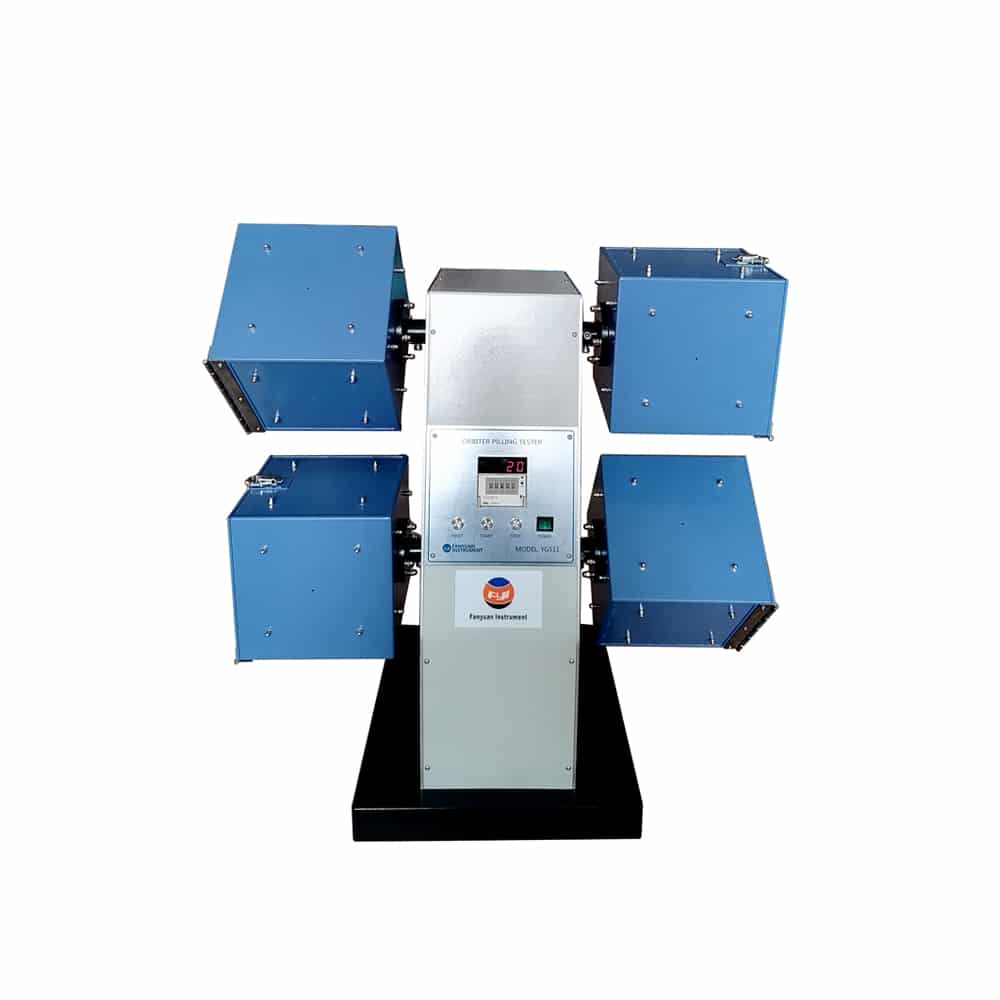
Atlas Random Tumble Method(e.g., ASTM D3512)
Diamond-shaped specimens with sealed edges (if adhesive is used for sealing, allow to dry for 2 hours before testing) are tumbled randomly inside a drum lined with standard cork; the degree of fuzzing and pilling is evaluated after a specified duration. The image below shows the Atlas random tumble testing instrument.

Requirements for each test method
ISO 12945-2 Martindale method
For woven or knitted fabrics other than upholstery (tested according to ISO 12945-2, the Martindale method), a minimum of 2,000 rubs is required; however, pilling formed at 2,000 rubs may be worn away by 7,000 rubs, making the results at 7,000 rubs the most representative of actual in-use performance.
Table 1 Requirements for the ISO 12945-2 Martindale test method
| Fabric Type | Abrasive Type | Load weight | Evaluation period | Number of friction cycles |
| Upholstery | Standard wool abrasive | 415±2 | 1 | 100 |
| 2 | 1000 | |||
| 3 | 2000 | |||
| 4 | 5000 | |||
| Woven fabrics (excluding upholstery) | Test specimen or standard wool abrasive | 415±2 | 1 | 125 |
| 2 | 500 | |||
| 3 | 1000 | |||
| 4 | 2000 | |||
| 5 | 5000 | |||
| 6 | 7000 | |||
| Knitted fabrics (excluding upholstery) | Test specimen or standard wool abrasive | 155±2 | 1 | 125 |
| 2 | 500 | |||
| 3 | 1000 | |||
| 4 | 2000 | |||
| 5 | 5000 | |||
| 6 | 7000 |
ISO 12945-1 ICI Pilling Box Method
For the ISO 12945-1 ICI Pilling Box tester, the number of revolutions is 10,800 (3 hours) for knitted fabrics and 18,000 (5 hours) for woven fabrics.
ASTM D3512 Atlas Random Tumble Method
Table 2 lists the requirements for the ASTM D3512 Atlas Random Tumble Test method.
| Technical Details | Requirements |
| Cork lining inside the drum | Each side can be used for 1 hour; after every hour of rotation, the drum must be cleaned with a cloth soaked in detergent. |
| Grey cotton fibers | Grey cotton fibers (6 mm in length, 25 mg in weight) must be placed inside the rotating drum to enhance the visibility of pilling on the specimen. |
| Specimen rotation time in the drum | Typically 30 minutes, or as specified by the client. |
Evaluation of results from the various test methods
ISO 12945-2 Martindale method
During rating, place the tested specimen and the original specimen side-by-side in the rating cabinet, with the tested specimen on the left and the original on the right. Assess the degree of pilling based on the descriptions in the table below, where Grade 5 represents the best condition and Grade 1 the worst; if the specimen falls between two grades, a half-grade rating (e.g., Grade 3–4) should be assigned. The line of sight must be perpendicular to the specimen at a distance of 30 cm to 50 cm, and the angle of incident light should be between 5° and 15°. Standard reference photographs may also be used for comparison, and the assessment must be performed by at least two people.
Table 3 ISO 12945-2 Martindale method assessment criteria
| Grade | Description |
| 5 | No change |
| 4 | Slight surface fuzzing and/or localized pilling |
| 3 | Moderate surface fuzzing and/or moderate pilling; the size and density of the pills cover a portion of the specimen surface |
| 2 | Significant surface fuzzing and/or significant pilling; the size and density of the pills cover the majority of the specimen surface |
| 1 | Dense surface fuzzing and/or severe pilling; the size and density of the pills cover the entire specimen surface |
12945-1 ICI Pilling Box Method
The rating method is the same as the ISO 12945-2 Martindale method described above, except that the pilling grade is assigned according to the descriptions in Table 4.
Table 4 ISO 12945-1 ICI Pilling Box Method Evaluation Criteria
| Grade | Description |
| 5 | No change in appearance |
| 4 | Slight change in appearance, e.g., slight fuzzing |
| 3 | Moderate change in appearance, e.g., any one or both of the following: (a) moderate fuzzing; (b) formation of pills |
| 2 | Severe change in appearance, e.g., distinct fuzzing or pilling |
| 1 | Very severe change in appearance, e.g., dense fuzzing or pilling covering the specimen |
ASTM D3512 Atlas Random Tumble Method
Grading is performed in a rating cabinet by comparing the specimen against ASTM reference photographs for fuzzing and pilling. The specimen is placed on the left and the photograph on the right; the angle of incident light is 5° to 15°, and the line of sight is perpendicular to the specimen. At least three people should participate in the grading process. The descriptions for each grade are as follows.
Table 5 ASTM D3512 Atlas Random Tumble Method Evaluation Criteria
| Grade | Description |
| 5 | No fuzzing or pilling |
| 4 | Slight fuzzing or pilling |
| 3 | Moderate fuzzing or pilling |
| 2 | Severe fuzzing or pilling |
| 1 | Very severe fuzzing or pilling |
Factors Affecting Fabric Pilling and Methods for Improvement
Factors Affecting Fabric Pilling
The influence of the yarn
Yarn fineness, twist, and surface smoothness significantly influence fabric pilling. Generally, the finer the yarn, the lower the likelihood of pilling. Higher twist levels result in tighter fiber cohesion, reducing the chance of fiber slippage within the yarn during friction and thereby minimizing pilling; however, since customers often desire a soft hand-feel for knitted fabrics—and excessive twist can make the fabric feel stiff—increasing twist is not a viable solution for preventing pilling. Finally, yarns with higher surface smoothness have shorter and fewer surface fuzz fibers, making them less prone to pilling.
The Influence of Fabric Structure
Generally, fabrics with loose structures are more prone to pilling than those with tight structures; for instance, knitted fabrics tend to pill more easily than woven fabrics, while plain-weave fabrics are less prone to pilling than twill-weave fabrics. This is because tightly structured fabrics are less likely to develop surface fuzz when subjected to external friction; furthermore, any existing fuzz is less likely to migrate to the surface due to the higher frictional resistance between fibers, thereby reducing the likelihood of pilling. Additionally, the smoothness of the fabric surface significantly influences pilling propensity: smooth-surfaced fabrics are less prone to pilling, whereas fabrics with uneven surfaces are more susceptible. Consequently, among knitted fabrics, the resistance to pilling improves progressively from patterned knits to ribbed knits and finally to plain knits.
The Impact of Dyeing and Finishing Processes
The pilling resistance of fabrics undergoes significant changes following dyeing and finishing treatments, a process influenced by the specific dyes, auxiliaries, and processing conditions employed. Generally, fabrics dyed at the garment stage are more prone to pilling than those woven from pre-dyed yarns; however, pilling resistance can be substantially improved through setting treatments such as resin finishing. Additionally, for fabrics woven from staple fiber yarns, the singeing process can help mitigate fuzzing and pilling.
Methods to Reduce Fabric Pilling

There are various established methods for improving the pilling resistance of textiles, such as modifying fiber composition and properties, altering yarn structure through spinning process adjustments, changing fabric construction, and selecting appropriate dyeing and finishing processes. These methods are detailed below:
Selecting fibers less prone to pilling during yarn and fabric production; for instance, pure cotton knits are less likely to pill than polyester-cotton blends.
Minimizing friction during the mass production of yarns and fabrics, such as by using suitable yarn lubricants.
Singeing or shearing. These methods remove surface fuzz, reducing the number of fiber ends exposed on the fabric surface and thereby making the fabric less susceptible to pilling.
Biopolishing. This process involves applying cellulase enzymes to the fabric surface; the combined action of washing and mechanical agitation removes surface fuzz and protruding fiber ends, resulting in a clearer fabric structure. Because fiber ends are removed rather than merely covered, the anti-pilling effect is durable; however, process conditions must be strictly controlled to avoid loss of fabric weight and strength.
Resin finishing. Applying resin to the fabric surface creates a cross-linked, network-like film that encapsulates the fibers, thereby reducing fiber slippage. Additionally, the resin cross-links and binds fibers to the yarn surface, making them less likely to pill during friction and thus improving the fabric’s pilling resistance.
Conclusion
The degree of pilling in textiles is influenced by numerous factors, including fiber composition and properties, yarn structure, fabric construction, and dyeing and finishing processes. Therefore, improving pilling resistance requires a comprehensive approach that identifies and controls the key factors among these variables.
Reference: Light Textile Industry and Technology (2012.02)— “Textile Pilling Resistance Testing and Analysis of Common Causes of Pilling” .If any copyright infringement is detected, please contact us.